
Salesforce Migration & Consolidation
Surgically moving revenue-critical data without losing a single relationship or deal.
Surgically Moving Revenue Data
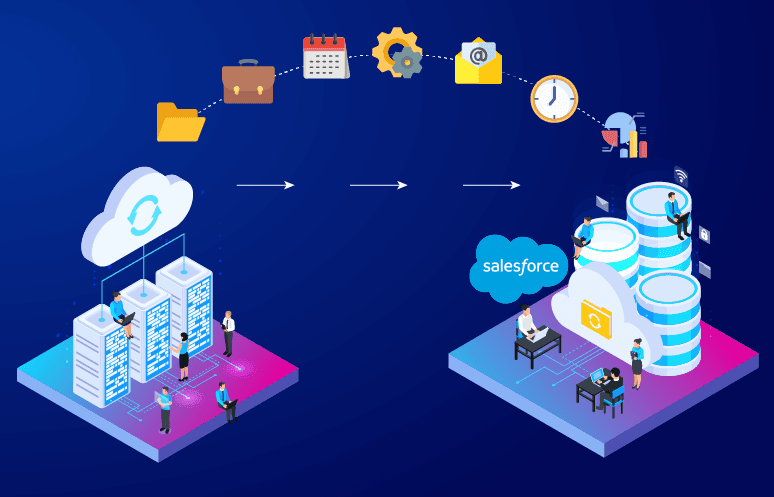
Migrating away from legacy CRMs like Dynamics 365, HubSpot, or bespoke SQL databases into Salesforce is a perilous maneuver. If contact-to-account mapping is flawed, sales teams instantly lose access to critical historical touchpoints — threatening active million-dollar pipeline deals and severing relationships that took years to build.
We execute mathematically precise data migrations. Our process aggressively sanitizes incoming data — merging duplicates, standardizing address formats, normalizing picklist values, and validating referential integrity — before injecting it seamlessly into the new Salesforce schema via the Bulk API. Every record is traced, every relationship preserved, every attachment reconnected.
For M&A scenarios involving multiple Salesforce orgs, we handle the uniquely complex challenge of consolidating two fully customized environments — different object models, different automation, different permission structures — into a single unified org without disrupting the revenue operations of either legacy organization during the transition.
M&A and Migration Challenges
The most dangerous moment in any CRM migration is when a sales rep opens their account list on Monday morning after a weekend cutover and half their opportunities are missing, their activity history shows zero, and their carefully maintained notes about the VP of Procurement's preferences have vanished into the data transformation void.
Equally treacherous are M&A consolidation scenarios where two companies — each with their own deeply customized Salesforce org, custom objects, apex triggers, and integration points — must merge into one without either organization's pipeline reporting going dark for even a single business day.
Without immediate structural intervention, these symptoms accelerate organizational drag and reduce operational agility.
Resource allocation becomes permanently skewed toward maintaining legacy workarounds rather than driving net-new innovation.
What We Deliver
Salesforce expertise that maximizes platform ROI and drives measurable revenue outcomes for your organization.
Legacy CRM Data Extraction
Pulling pristine, complete datasets safely out of aging and competing CRM platforms. We handle the unique extraction challenges of each platform — HubSpot's API rate limits, Dynamics' complex entity relationships, Zoho's nested module structures — ensuring no data is left behind.
- HubSpot, Dynamics 365, Zoho, SugarCRM, and Pipedrive extraction with full relationship preservation
- Relational ID mapping maintaining parent-child account hierarchies, contact-to-opportunity associations, and activity threading
- Historical email and activity log synchronization preserving the complete communication timeline per contact
- Custom object and attachment extraction including documents, contracts, and embedded images
Org-to-Org Salesforce Consolidation
Merging two distinct Salesforce instances into a single unified org post-merger or acquisition. This requires deep structural alignment of custom objects, field mapping across different naming conventions, automation deconfliction, and careful permission model unification.
- Custom object structural alignment merging equivalent objects with different schemas into a unified model
- Profile and Permission Set mapping ensuring users from both organizations retain appropriate access levels
- Metadata API deployment consolidating page layouts, validation rules, and automation from both source orgs
- Duplicate Account and Contact resolution using fuzzy matching algorithms and manual review workflows
Data Cleansing & Enrichment
Transforming messy, inconsistent legacy data into highly actionable intelligence before it enters the new Salesforce environment. We never migrate garbage — every record is validated, standardized, and enriched to ensure the new system launches with trustworthy data that users can rely on from day one.
- Deduplication using DemandTools or Cloudingo with configurable matching rules and merge logic
- Address, phone, and email format standardization using third-party verification APIs
- Lead scoring recalculation based on updated firmographic and behavioral data attributes
- Data enrichment using ZoomInfo, Clearbit, or D&B to fill gaps in company size, industry, and revenue fields
Validation & User Acceptance Testing
Rigorous multi-layer testing that validates every migrated record before the production cutover. We do not trust automated migration tools blindly — we verify record counts, referential integrity, field-level accuracy, and automation behavior through systematic UAT with actual business users.
- Record count reconciliation comparing source system totals against Salesforce landing counts per object
- Referential integrity validation ensuring every Opportunity links to the correct Account and Contact
- Automation smoke testing verifying that triggers, flows, and validation rules behave correctly on migrated data
- User Acceptance Testing sessions with sales, service, and operations teams validating their specific workflows
Data Migration Protocol
A systematic approach to moving CRM data accurately and safely.
Field Mapping
We align every single legacy field to a Salesforce destination — including data type conversions, picklist value translations, and formula field recreations. Fields without a clear destination are documented for stakeholder review rather than silently dropped.
Cleansing & Preparation
We strip HTML tags, fix malformed email addresses, standardize phone formats, merge identified duplicates, and remove obviously outdated records (e.g., contacts with bounced emails, accounts with no activity for 5+ years). Stakeholders approve every exclusion rule before execution.
Test Load & Validation
We inject 5-10% of the data into a Full Sandbox to validate relationship integrity, automation behavior, and report accuracy. Business users execute pre-defined test scenarios confirming their workflows function correctly. Issues are logged and remediated before proceeding.
Production Cutover
We execute the final migration precisely during the planned weekend window using the Salesforce Bulk API. Delta records created between test load and cutover are captured through change tracking. Post-cutover validation confirms 100% record accuracy before users access the system Monday morning.
Industry Applications
Salesforce solutions calibrated for your industry's specific regulatory, competitive, and operational landscape.
Consolidating CRM instances from 5 acquired portfolio companies — each running different Salesforce editions with conflicting custom objects — into a unified org with standardized pipeline stages, consistent reporting metrics, and centralized portfolio-level dashboards.
Migrating 15 years of client engagement history from a custom-built SQL database into Salesforce Service Cloud — preserving project timelines, SOW attachments, billing records, and resource allocation data that drive recurring revenue and relationship management.
Transitioning from Raiser's Edge and legacy donor management systems to Salesforce NPSP (Nonprofit Success Pack) — preserving donor giving history, pledge commitments, campaign attribution, and grant tracking data critical for annual fundraising cycles.
Related Services

Salesforce Implementation
Deploying brand-new, perfectly optimized Salesforce instances tailored to your exact industry.
Salesforce Consulting & Strategy
Transforming standard CRM deployments into elite, customized revenue-generation engines.
AWS Migration Services
Zero-downtime, secure migrations from on-premise or other clouds to AWS.
Azure Migration Services
Secure, structured migrations transitioning legacy systems to Microsoft Azure.
Salesforce Implementation
Deploying brand-new, perfectly optimized Salesforce instances tailored to your exact industry.
Salesforce Consulting & Strategy
Transforming standard CRM deployments into elite, customized revenue-generation engines.
AWS Migration Services
Zero-downtime, secure migrations from on-premise or other clouds to AWS.
Azure Migration Services
Secure, structured migrations transitioning legacy systems to Microsoft Azure.