Salesforce Implementation
Launching revenue operations on a pristine, optimized platform — built right from day one.
Launching Revenue Operations Right
The decisions made during the very first week of a Salesforce deployment dictate the system's success for the next decade. Choosing the wrong Account hierarchy model, failing to establish strict User Profiles and Permission Sets, or deploying without proper data validation rules immediately creates a tangled architecture that is incredibly painful and expensive to unwind later.
We deploy Sales Cloud, Service Cloud, and Revenue Cloud from scratch — building on industry best practices and your specific operational requirements. By enforcing correct architecture from day one, we guarantee your teams are handed a pristine, lightning-fast platform that accelerates sales velocity instead of introducing new administrative burden.
Our implementation methodology goes far beyond technical configuration. We embed change management into every phase — ensuring that the business teams who will live in Salesforce daily are involved in design decisions, trained on the specific workflows they will use, and supported through the adoption curve that determines whether the system becomes indispensable or abandoned.

The Risk of Poor Go-Lives
We routinely rescue organizations from implementation failures — systems where 40 required fields on the Lead object guarantee that nobody will ever log a lead, where Organization-Wide Defaults are set to 'Public Read/Write' letting every rep see every deal, and where sales stages have no defined exit criteria so pipeline reports are meaningless.
The most common implementation failure is not technology — it is the absence of user-centered design. When a CRM is implemented by technologists without deep involvement from the actual sales, service, and operations teams who will use it daily, the result is a system that satisfies an IT requirements document but is actively avoided by the people it was meant to serve.
Without immediate structural intervention, these symptoms accelerate organizational drag and reduce operational agility.
Resource allocation becomes permanently skewed toward maintaining legacy workarounds rather than driving net-new innovation.
What We Deliver
Salesforce expertise that maximizes platform ROI and drives measurable revenue outcomes for your organization.
Sales Cloud Configuration
Configuring the ultimate B2B sales automation engine — from lead capture through closed-won handoff. We design every object, field, page layout, and automation to minimize the number of clicks a rep needs to update their pipeline while maximizing the data quality and visibility that management requires for accurate forecasting.
- Lead routing and assignment rules with territory management, round-robin, and skill-based distribution
- Opportunity pipeline modeling with custom sales stages, probability weighting, and mandatory exit criteria
- Forecasting hierarchy configuration with collaborative forecasting and submissions-based rollups
- Einstein Activity Capture for automated email and calendar synchronization without manual logging
Service Cloud Deployment
Building omnichannel customer support centers that resolve cases faster through intelligent routing, self-service portals, and automated knowledge base suggestions. We configure Service Cloud to reduce average handle time while improving customer satisfaction scores through consistent, informed responses.
- Case routing via Omni-Channel with skill-based assignments and priority-weighted queue management
- Email-to-Case and Web-to-Case configuration with automated triage and SLA milestone tracking
- Knowledge Base structuring with article versioning, approval workflows, and suggested articles on case creation
- Customer self-service portal deployment using Experience Cloud with case submission and knowledge search
Experience Cloud Portals
Extending your Salesforce data securely to external partners, customers, and distributors through branded web portals. We build portals that provide self-service capabilities while maintaining strict data isolation — ensuring partners see only their own data and customers access only their own cases and orders.
- Partner Deal Registration portals with lead and opportunity submission, approval workflows, and commission visibility
- Customer self-service case management with real-time status tracking and file attachment capabilities
- Branded Lightning Web Component interfaces matching your corporate design system within the portal experience
- Guest user access configuration with proper sharing rules preventing any data leakage to unauthenticated visitors
Automation & Workflow Design
Building the intelligent automation layer that eliminates manual task execution, enforces business processes, and keeps data flowing between Salesforce objects and external systems without human intervention. We design automation that is maintainable, testable, and documented — not the tangled Flow-on-Flow-on-Process-Builder mess that most orgs accumulate.
- Record-Triggered Flow design for complex multi-step automation with error handling and rollback capabilities
- Scheduled Flow implementation for nightly batch operations like lead aging, opportunity stale-deal flagging, and data cleanup
- Approval Process configuration for discount approvals, contract reviews, and expense authorization chains
- Integration-triggered automation firing Platform Events to external systems on specific Salesforce record changes
Implementation Methodology
A structured deployment ensuring the platform is built correctly from the foundation up.
Discovery & Requirements
We gather requirements through structured workshops with every stakeholder group — sales leadership, individual contributors, marketing ops, customer success, finance, and IT. We document user stories with clear acceptance criteria, prioritize by business impact, and define the MVP scope for the initial go-live.
Configuration & Build
We configure the security model (Profiles, Permission Sets, OWD, sharing rules), design the object model, build page layouts, and implement automation — all in a development sandbox. Every configuration decision is documented in a design specification that becomes the system's institutional knowledge.
Integration & Automation
We build the integration layer connecting Salesforce to your email platform, marketing automation, ERP, and any other critical systems. We implement the business automation rules (Flows, approval processes, notification triggers) and validate end-to-end process execution across system boundaries.
Training & Go-Live
We deliver tailored training for each user role — sales reps get pipeline management training, service agents get case handling training, managers get reporting and dashboard training. We execute a controlled go-live with dedicated hypercare support during the first 30 days.
Industry Applications
Salesforce solutions calibrated for your industry's specific regulatory, competitive, and operational landscape.
Implementing a full Lead-to-Cash stack including Sales Cloud, CPQ, and Billing — supporting complex usage-based pricing models, multi-year contracts with annual escalators, and automated renewal opportunity generation 90 days before contract expiration.
Deploying Sales Cloud with custom Project Management objects that track resource allocation, time entry, and milestone billing — providing visibility from initial sales engagement through delivery completion and client satisfaction measurement.
Implementing Health Cloud for patient relationship management with referral tracking, care plan coordination, and HIPAA-compliant communication channels — enabling coordinated care across provider networks with appropriate data sharing controls.
Related Services
Salesforce Consulting & Strategy
Transforming standard CRM deployments into elite, customized revenue-generation engines.
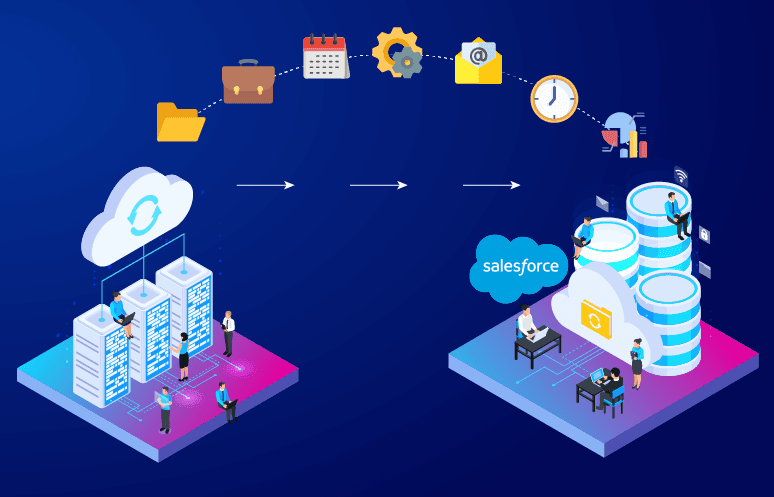
Salesforce Migration & Consolidation
Merging multiple CRM instances and securely transferring gigabytes of historical data into Salesforce.
Salesforce Custom Development
Engineering complex Apex code, Lightning Web Components, and intricate API integrations.

Salesforce Einstein & AI
Deploying predictive forecasting, automated service replies, and Einstein AI capabilities.
Salesforce Consulting & Strategy
Transforming standard CRM deployments into elite, customized revenue-generation engines.
Salesforce Migration & Consolidation
Merging multiple CRM instances and securely transferring gigabytes of historical data into Salesforce.
Salesforce Custom Development
Engineering complex Apex code, Lightning Web Components, and intricate API integrations.
Salesforce Einstein & AI
Deploying predictive forecasting, automated service replies, and Einstein AI capabilities.